


You’ve probably seen the phrase “voted by proxy” in a news headline or “proxy server” in your computer settings. While it sounds technical, the idea behind it is something you already understand: letting someone else act for you. How do I find the best datacenter proxies?
At its heart, a proxy is an authorized substitute. Think of it like sending a friend to pick up a package for you while you’re at work; they are acting on your behalf, with your permission. That is the fundamental meaning of proxy. It’s an official term for giving someone the power to stand in for you when you can’t be there yourself.
This core idea appears in surprisingly different contexts. In the corporate world, shareholders who can’t attend a meeting often authorize someone to cast their vote. In technology, a proxy server acts as a middleman for your computer on the internet, providing security or privacy. Ultimately, what does by proxy mean? It’s a way to delegate a task or action by using an authorized stand-in.
What Defines a Proxy?
For an action to be done by proxy, two key ingredients are essential: authorization and representation. Authorization is the permission you grant—the formal “yes, you can do this for me.” Representation is the act itself, where your proxy speaks or acts with your authority.
This is what separates acting by proxy from simply asking a friend for a casual favor. It involves a clear, often documented, transfer of your right to perform a specific action. Asking a coworker to grab you a coffee is a favor. However, giving that coworker a signed form to cast your vote at an official company meeting means they are acting as your proxy. That level of formal authority is what gives the action its weight, especially in settings where decisions rely on these authorized actions, from corporate boardrooms to community associations.
How Does Proxy Voting Actually Work in a Shareholder Meeting?
The most common example of a proxy is in a shareholder meeting. If you own stock, you are a shareholder—technically a part-owner of the company—with the right to vote on big decisions. Since most shareholders can’t fly to an annual meeting, companies use proxy voting to allow them to participate.
The process officially begins when the company mails you a proxy statement. This document is an official voter’s guide, explaining the issues that will be decided at the upcoming meeting, such as electing the board of directors or approving a corporate merger. This statement gives you all the necessary background to make an informed choice.
Included with that statement is the most important part: the proxy card. This is your ballot. On this card, you check boxes to direct a designated person—the proxy—exactly how you want your shares to be voted. By signing and returning it, you are giving that person formal authorization to cast your vote according to your specific instructions, just as if you were in the room yourself.
This system is far more than just a convenience; a company needs to function. For a shareholder meeting to be valid, a certain number of shares must be represented, a requirement known as a quorum. By enabling thousands of scattered shareholders to participate via proxy, a company can gather enough votes to make legitimate decisions and move forward.
Your Step-by-Step Guide to Filling Out a Proxy Form
When that official-looking envelope arrives, filling out a proxy form is more straightforward than you might think. Your proxy statement explains the details, but the ballot itself—the proxy card—is where you take action. The first step is to review the specific items up for vote, often listed as “Proposals” or “Matters for Vote.”
Once you understand the proposals, you can cast your vote. Your ballot will guide you through a simple process:
- Review the Proposals: Identify the key issues, such as the “Election of Directors” or “Approval of Executive Compensation.”
- Mark Your Votes: For each item, you can typically choose For, Against, or Abstain (which withholds your vote).
- Sign and Date to Authorize: Your signature is what legally turns the card into a valid proxy, giving the designated person permission to cast your vote as directed.
Finally, and most critically, pay attention to the submission deadline. A proxy vote is only counted if it’s received by the cut-off date printed on the form. Missing that deadline is like showing up to the polling station after it has closed. By signing and returning it on time, you ensure your voice is officially heard.
Proxy vs. Power of Attorney: What’s the Real Difference?
As you authorize someone to act on your behalf, another legal term might come to mind: Power of Attorney (POA). While they sound similar, the core difference comes down to scope. Think of it as the difference between giving someone a ticket for a single movie versus handing them a full-access pass to the entire film festival.
The legal definition of a proxy centers on this limited authority. A proxy is typically for a single, specific event and is a temporary, single-use power. As a classic acting by proxy example, if you assign a proxy for a meeting but later decide to attend yourself, your physical presence automatically cancels the proxy. Your authority overrides theirs instantly.
A Power of Attorney, on the other hand, grants much broader and more lasting responsibility. It’s a formal document you might use to let a trusted person manage your financial or medical affairs if you were unable to. This isn’t for a one-time vote; it’s for ongoing duties like paying bills, making healthcare decisions, or managing investments. Ending a Power of Attorney requires a formal, legal revocation process. The distinction is clear: a proxy is for a specific task, while a Power of Attorney is for an ongoing role.
A Proxy Server: Your Computer’s Middleman on the Internet
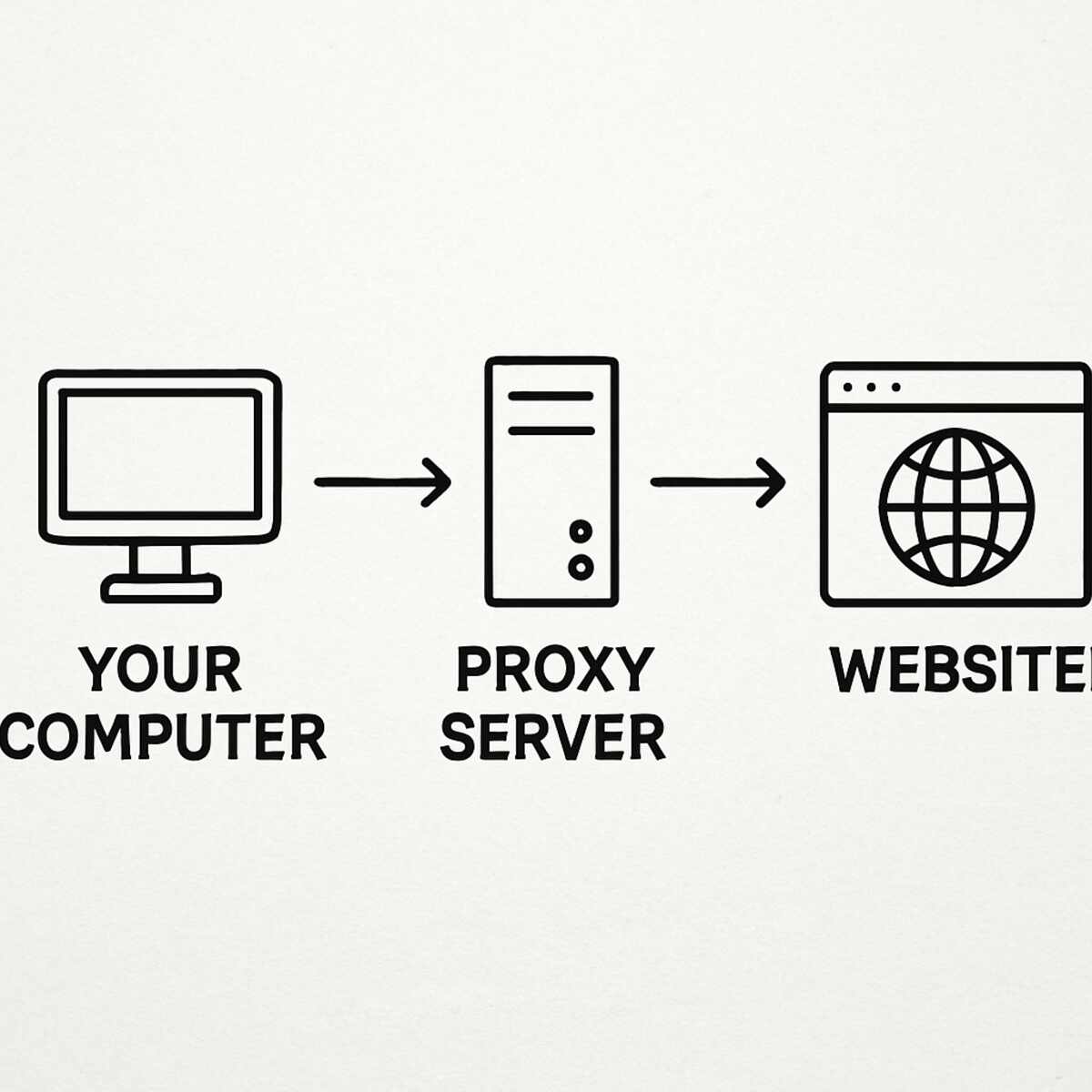
Just as a person can act as your proxy in a meeting, a proxy server acts as a stand-in for your computer on the internet. Normally, when you visit a website, your device makes a direct request to that site. Using a proxy changes this. Instead, your computer sends the request to the proxy server, which then forwards it to the website for you.
To understand what a proxy server is for, you first need to know about your IP address. Think of it as your computer’s unique mailing address online; it reveals your general location to every site you visit. A proxy server’s primary job is to provide digital privacy. When it forwards your request to a website, it uses its own IP address, not yours. The website only ever sees and interacts with the proxy, keeping your personal IP address hidden.
This ability to mask your location has a very practical use: getting around geo-restrictions. If you’ve ever tried to watch a video only to see a message like, “This content is not available in your country,” websites enforce these rules by checking your IP address. By connecting through a proxy server in another country, you can make it appear as if you’re browsing from there, unlocking a world of content.
VPN vs. Proxy Server: Which One Do You Actually Need?
While both a proxy and a VPN act as a middleman for your internet traffic, a VPN offers a much higher level of security and privacy. Think of a proxy server as a quick disguise for a single activity. In contrast, a VPN (Virtual Private Network) is like a full suit of armor for your entire internet connection. It doesn’t just cover your browser; it routes and protects all the traffic from every app on your device.
The most crucial difference is encryption. A VPN creates a secure, private “tunnel” for your data and scrambles it into unreadable code. This means that even if someone intercepted your traffic—like a hacker on a public Wi-Fi network—they wouldn’t be able to see what you’re doing. Most proxy servers simply pass your information along without this critical layer of protection.
So, when should you use one over the other? It comes down to your goal.
- Use a Proxy for: Simple, low-stakes tasks, like accessing a single region-blocked website or YouTube video.
- Use a VPN for: Overall privacy and security, especially when using public Wi–Fi, accessing your bank account, or wanting to keep all your online activity private.
Ultimately, a proxy is a tool for a specific job, while a VPN is a comprehensive service for your digital life.
What Are the Real Risks of Using a (Free) Proxy?
The appeal of a free tool is strong, but the risks of using a proxy server—especially one that costs nothing—can be significant. At a minimum, you’ll likely face performance issues. Because free proxies are often overloaded with users, your internet connection can become frustratingly slow or drop without warning.
A more serious concern is your privacy. There’s a common saying in the tech world: “If the service is free, you are the product.” Since the proxy server is the middleman for all your web browsing, its owner can see and record every website you visit. Many free proxy providers survive by logging this activity and selling your data to advertisers.
In a worst-case scenario, the proxy server isn’t just nosy—it’s actively malicious. Because your information passes directly through it, a criminal could run a proxy service to intercept your data. They might inject aggressive ads into the websites you visit or, even worse, attempt to steal sensitive details like passwords and credit card numbers. It’s the digital equivalent of giving your mail to a stranger who promises to deliver it but might be reading it first.
A Curious Case: How Do Proxy Marriages Work?
The idea of a “stand-in” can extend to some of life’s biggest moments, including getting married. A proxy marriage is a legal wedding where one or both partners are represented by someone else. This proxy literally stands in for the absent partner during the ceremony, allowing the union to be legally recognized even with thousands of miles in between. It’s a profound example of acting by proxy.
However, this practice is extremely rare and its legality is determined entirely by local laws. In the United States, for instance, only a handful of states like Colorado and Montana allow it, and often only under very specific conditions. You can’t simply decide to have a proxy wedding anywhere you’d like; the location of the ceremony dictates the law.
Its most common use is for members of the armed forces on active duty. When a service member is deployed and cannot be physically present, a proxy marriage allows them to legally wed their partner. This practical step ensures the couple can receive important spousal benefits, like health insurance or housing allowances, without having to wait for the deployment to end.
Living Vicariously: What Does ‘By Proxy’ Mean in Psychology?
Beyond formal legal acts, you might also hear the phrase used in a deeply personal, psychological way. This is the idea of “living by proxy,” which means experiencing emotions and achievements through another person’s life. It’s a form of living vicariously, where someone else’s experiences become a substitute for your own. In this context, the term has no legal or technical weight; it’s all about feeling.
At its heart, this is a form of emotional substitution. Think of a parent watching their child score the winning goal. The parent isn’t on the field, but they feel the rush of victory almost as if they were. In that moment, the child is acting as a proxy for the parent’s emotional fulfillment.
This emotional connection can be both positive and negative. It’s positive when you feel a surge of genuine pride for a friend’s success. However, it can become unhealthy when someone pressures another to fulfill a dream they themselves couldn’t achieve, like a parent forcing a child into a specific career. Unlike a legal proxy, this emotional stand-in holds no official power—it’s simply about how we connect our feelings to the lives of others.
From Voting to Web Browsing: The Power of a Proxy
Where the phrases “proxy vote” and “proxy server” once seemed like unrelated technical terms, you can now see the simple, powerful idea connecting them. Whether it involves a person, a document, or a piece of software, the concept of proxy always comes back to one thing: an authorized stand-in.
As you read the news, browse your computer’s settings, or hear about a formal meeting, you can now listen for the term “proxy” with confidence. Each time you recognize it, you’ll reinforce your understanding of its core meaning—an act of trusted substitution.
You are now equipped to navigate these contexts without hesitation. The next time you encounter the phrase, you won’t just recall a definition; you will understand precisely what is happening and why.
