


Remember that rainy afternoon? You had a deck of cards, a bit of time, and an ambitious goal: to build a magnificent house of cards. Ten seconds later, all you had was a flat pile of frustration. What if the problem wasn’t your steady hand or a sudden breeze? For most people, the failure is built into the method, as we try leaning one slick card against another, a technique doomed to slide apart. Check out cadetv.com to know more
The real secret behind the house of cards game isn’t about superhuman stillness; it’s about simple geometry. Successful card stackers know that the entire structure relies on one surprisingly stable shape. Instead of leaning cards, they build with small, self-supporting triangles that form a foundation that practically does the balancing for you. This single shift in technique is the difference between a frustrating mess and a stable, standing structure.
Forget the guesswork and random leaning. This guide provides the exact blueprint for stacking playing cards successfully. You’ll learn how to build a stable base with the crucial first triangle, lock it in place, and add a second story—a feat most people think is impossible. By following these steps, you will build your first standing, multi-level, simple card pyramid today.
The 3 Things You Need Before Stacking a Single Card
Ever wonder why your cards instantly slide flat before you can even let go? The problem often isn’t your shaky hands; it’s your environment. Most failed attempts are doomed from the start because of an invisible trio of saboteurs: the surface, the cards themselves, and the air around you. Getting these three things right is the single biggest step you can take toward building a structure that actually stands up.
Before you start building, run through this quick setup check. Think of it as preparing your construction site.
- The Surface Test: Your biggest enemy is a slick, polished table. Cards need a tiny bit of friction to grip. Instead of a glossy wood or glass surface, try building on a tablecloth, a placemat, or even the slightly textured cover of a large hardcover book. This gives the card edges something to bite into.
- The Card Check: Not all decks are created equal. Old, bent, or warped cards will refuse to stand straight. On the other hand, brand-new cards can be incredibly slippery. Give your cards a quick inspection. If they’re bowed, try gently bending them back. If they feel slick as ice, consider a different, more worn-in deck.
- The Air-Flow Audit: A house of cards weighs almost nothing, making it extremely vulnerable to the slightest breeze. Close any nearby windows, and be mindful of air conditioning or heating vents. Even someone walking past your table too quickly can create enough of a draft to cause a total collapse. Your building zone should be a “no-fly zone.”
With your stage properly set, you’ve eliminated the most common reasons for failure. Now you’re ready for the one simple technique that makes it all possible.
Meet Your Secret Weapon: The 2-Card “A-Frame”
If you’ve ever tried balancing one card against another, you know the frustration of watching it slide apart. The problem isn’t your skill; it’s your strategy. Forget trying to lean single cards—the real secret is to create a single, strong shape that stands up all by itself. This shape is the most important building block in all of card stacking, and we’ll call it the “A-Frame” or “The Triangle.” It’s the simple card pyramid technique that beginners need to master first, and it’s the key to every stable tower you’ll ever build.
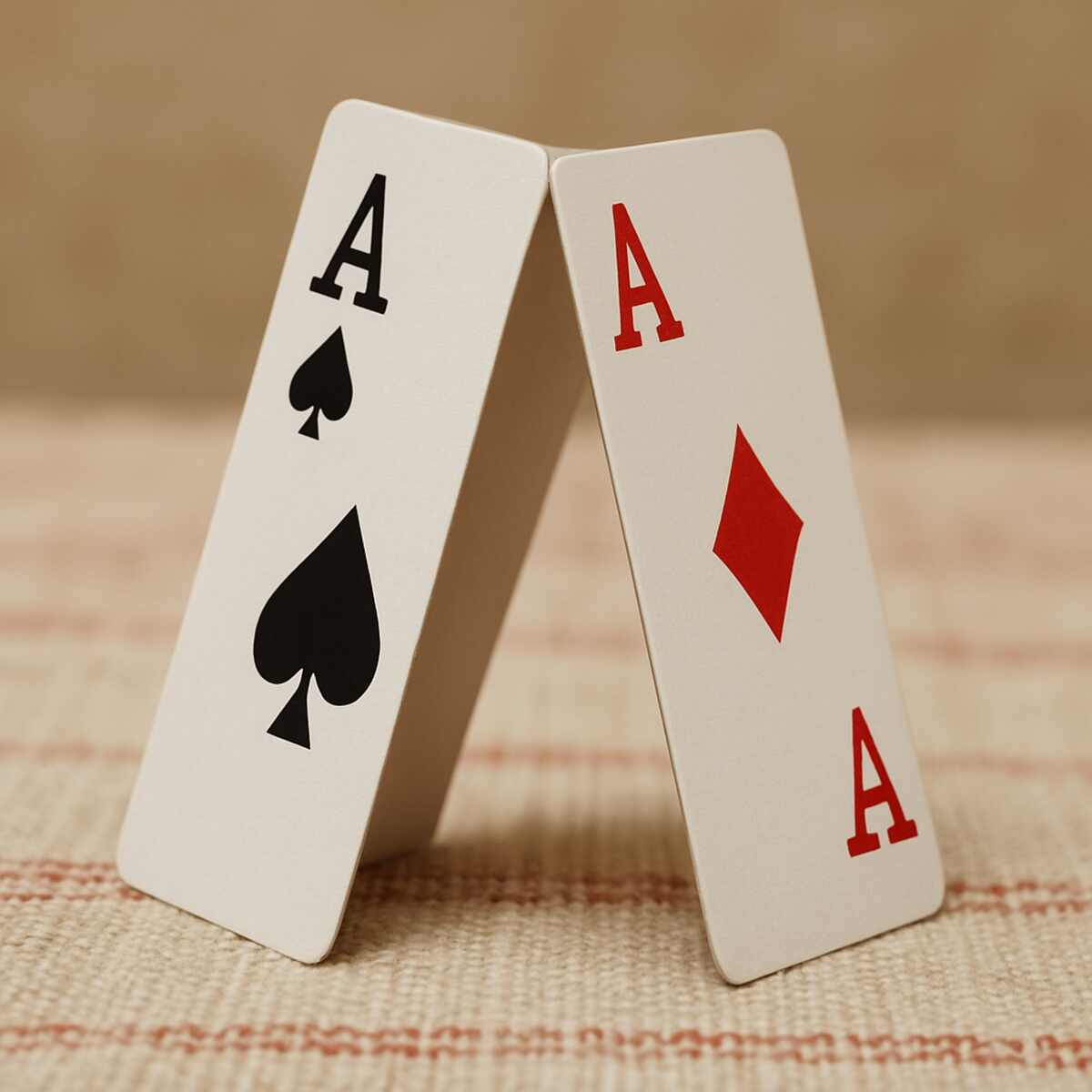
To build your first one, take two cards, holding one in each hand. Gently touch their top edges together while letting the bottom edges rest on your stable surface, about an inch or two apart. The result should look like a small, narrow tent or the letter ‘A’. Now, here’s the critical part: slowly and gently release your fingers. Don’t press down or make any sudden movements. The two cards should lean on each other, creating a structure that supports its own weight without any help from you.
This simple shape is the foundation of everything that comes next. Notice how it stands steady? The A-Frame does the balancing work for you. It’s an inherently stable unit. Your job isn’t to hold the cards still, but simply to place these A-Frames correctly. Once you can consistently create one that stands on its own, you’re ready to move beyond a single tent and start building a real structure.
How to Build Your First Floor Without a Total Collapse
Now that you’ve mastered the A-Frame, it’s time to turn that single, lonely tent into the solid foundation of a real house. One A-Frame is a great start, but a row of them working together is what creates a truly stable card tower base. This is the first step in the house of cards game that separates a wobbly lean-to from a sturdy structure, and it’s much simpler than you think.
Go ahead and carefully build a second A-Frame right next to your first, leaving a gap of about one card’s width between them. Here comes the essential trick for connecting them: take a single card and gently lay it flat across the top points of both A-Frames. Think of it as a small bridge. This single flat card is the secret ingredient, locking the two separate structures together so they support each other instead of standing alone.
With that first bridge in place, your base is already much stronger. You’ve now learned the basic pattern for how to stack playing cards horizontally. To complete the foundation, simply repeat the process. Build one more A-Frame next to the second one, maintaining that same small gap. Then, place another flat card to bridge the gap between your second and third A-Frames.
Take a step back and look at what you’ve built. Congratulations! You’ve just created a three-unit base—the complete first floor of your house. It should feel much more robust than a single triangle. But this raises a new question: how do you build on top of a row of pointy peaks and flat bridges? To go higher, you need to turn this uneven surface into a solid platform.
The Game-Changing Trick: Building a Solid Floor to Go Higher
That impressive base you just built has a problem: it’s a landscape of pointy peaks and empty gaps. If you try to balance a new A-Frame on top of those tiny points, it will almost certainly slide off, leading to a frustrating collapse. This is the exact spot where most attempts fail. The secret to how to make a card tower taller isn’t about balancing on those peaks; it’s about making them disappear entirely by building a solid, flat floor on top of them.
The technique is all about being gentle. Starting from one end of your base, take a single card and lay it flat, covering the first A-Frame and the bridge next to it. Don’t press down; just let the card’s own weight hold it in place. Overlap your next card slightly, like you’re laying shingles on a roof, and continue this process until the entire top of your first story is covered. This is one of the most important card tower building techniques, as it transforms your wobbly peaks into a sturdy platform.
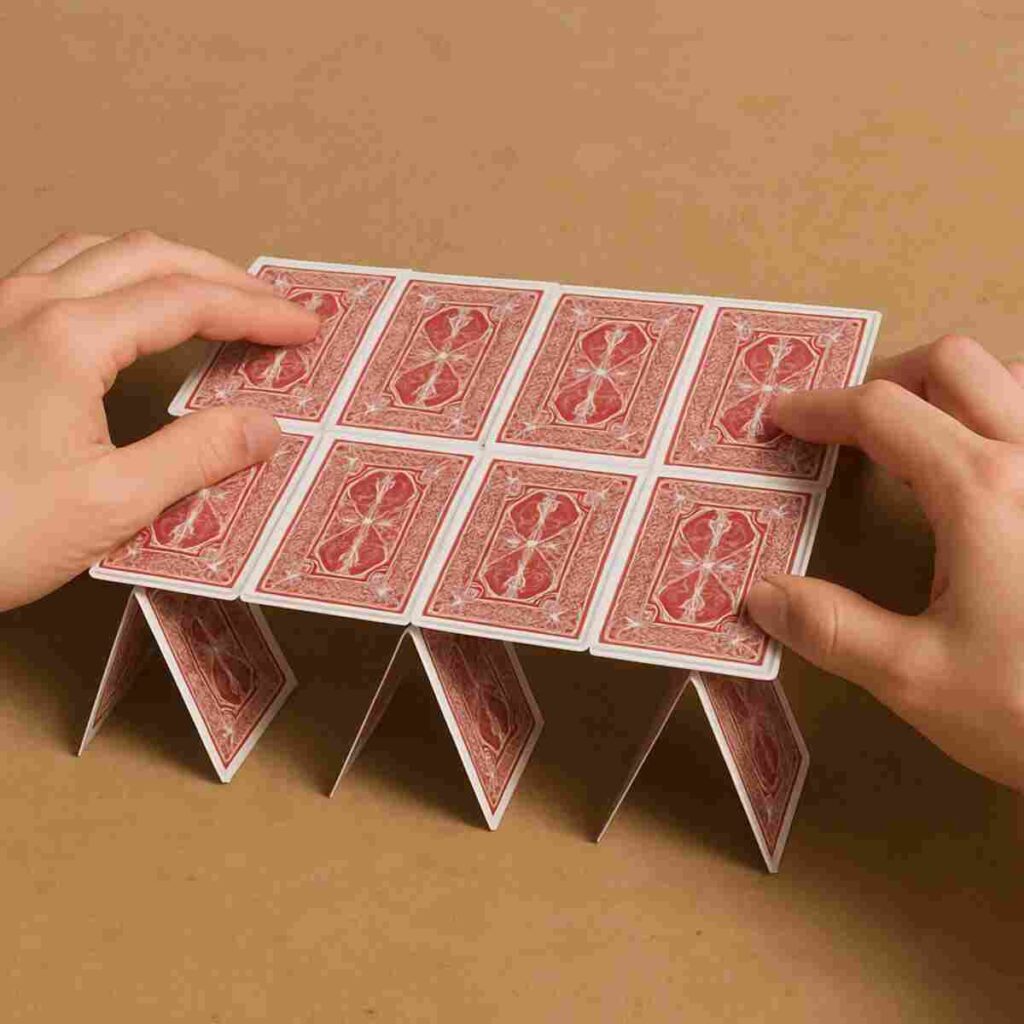
With this flat, solid second-story floor in place, you’ve essentially hit the reset button. You now have a perfect, stable surface that is ready for the next level. You’re no longer fighting gravity on a precarious edge; you’ve created an ideal foundation for building higher. This simple layer of cards is the single biggest difference between a one-story attempt and a multi-level success. Now that you have a new “table” to work on, you’re ready to conquer the second story.
Conquering the Second Story, One Gentle Placement at a Time
That solid platform you just built is the key to how to make a card tower taller. You’ve successfully created a new, smaller “table” high above the actual table. From here, the process should feel familiar because you’re simply going to repeat the first step you learned, just on a smaller scale. You already have the skill; now you’re just applying it at a new altitude. The goal is to build a new row of A-Frames directly on top of the flat floor you created.
The next step requires a gentle touch and a bit of strategy. If your first floor had three A-Frames, your second floor should only have two. Begin by building your first A-Frame right in the center of the platform, not near the edge. Once it’s stable, build your second A-Frame right next to it. By building a smaller, centered row, you ensure the weight of the new level is concentrated over the strongest part of the base below, dramatically increasing your chances of success. This is the fundamental technique behind most tall card pyramids.
Building inward is what separates a stable structure from a wobbly one. Once your two new A-Frames are standing, you can complete the second story. Just as before, gently lay a card or two flat across their peaks to create a small roof. This not only “caps” your creation but also adds a little weight that helps hold the second-story A-Frames together. This classic tiered shape is the foundation for many structures and is much more stable than attempting the four-card cells used in advanced card stacking designs like a card castle.
If your structure is still standing, take a moment to celebrate. You have officially built a successful, multi-story house of cards! It’s a challenge of patience and physics, and you’ve just won. Of course, sometimes, even with perfect technique, disaster strikes. If you found your tower collapsing as you added the final cards, don’t get discouraged—it happens to the best of us. The key is to understand why it happened by diagnosing the cause of the collapse.
“Why Did It Fall?!” A Troubleshooter’s Guide to Common Collapses
A spectacular collapse is a classic part of the house of cards game. Before you sweep the cards into a frustrated pile, take a look at the wreckage. The way your structure failed is a clue. If you find yourself asking, “why does my card structure keep collapsing?” the answer is rarely “bad luck.” Most failures come down to one of three common, and entirely fixable, problems.
Instead of just starting over and hoping for the best, let’s diagnose the specific type of collapse you experienced. A quick analysis will tell you exactly what to adjust for your next attempt.
- The Instant Slide: If your A-Frames slide apart almost immediately after you let go, your surface is the culprit. Playing cards have a glossy finish that offers almost no grip on a slick, polished table.
- The Fix: Try building on a slightly textured surface, like a tablecloth, a placemat, or even a large sheet of paper. This provides the friction the cards need to stay put.
- The Shiver and Quake: If the whole tower trembles and falls the moment you add a new card to the top, you’re likely applying too much pressure. It’s a common instinct to “place” a card firmly, but this sends vibrations through the whole delicate structure.
- The Fix: Don’t press down at all. Hold the card just millimeters above where you want it to go and simply let it drop. Gravity is all the force you need.
- The Buckling Leg: If one specific A-Frame suddenly gives way, with one of its “legs” kicking out from under the weight, your base was likely too wide. A short, wide triangle is much weaker than a tall, narrow one.
- The Fix: Make your A-Frames taller and skinnier. Aim for a shape that looks more like the letter ‘A’ and less like a low ramp. This concentrates the weight downward more effectively.
Learning to spot these issues is the real secret behind the physics of balancing playing cards. It transforms the process from a test of superhuman steadiness into a simple puzzle of observation and adjustment. Once you know what to look for, you can correct small instabilities before they lead to a total downfall.
With this troubleshooter’s guide, you now have the tools not just to build a structure, but to make it consistently stable. You’ve mastered the classic pyramid, which relies on A-Frames. Now you’re ready to learn the building block for even bigger creations.
Beyond the Pyramid: Your Next Challenge with the “4-Card Cell”
While the classic pyramid is a fantastic achievement, you’ve probably noticed its main limitation: it has to get smaller as it gets taller. But what if you wanted to build something bigger and boxier, like a castle with multiple rooms or a sturdy tower? For that, you need to graduate from the A-frame to a new building block: the 4-card cell. This is the secret behind nearly all sprawling, advanced card stacking designs.
The power of this new shape lies in its incredible stability. Unlike the A-frame, where two cards lean on each other, the 4-card cell is a self-supporting square where four cards interlock, each one bracing the others. Think of it as a small, open-topped box. When you place these cells next to each other, you create a grid, similar to the intersecting walls inside a building. This structure is far more resistant to shaking and can support much more weight than a simple line of A-frames.
This simple square might not look like much, but it’s the key that unlocks monumental creations. In fact, it’s the primary component in Bryan Berg card stacking methods—the MIT-trained architect who holds the world record for the tallest card structure. His astonishing creations aren’t built with magic or glue; they are built from thousands of these humble 4-card cells meticulously arranged in a grid. By learning this one technique, you’re no longer just balancing cards; you’re applying the same foundational principle used by the world’s best.
You’re Officially a Card Stacker! What This New Skill Reveals
That pile of frustrating, sliding cards is a thing of the past. You’ve traded guesswork for a system, transforming a seemingly impossible challenge into a predictable process. You now hold the fundamental secret of every stable structure: build with triangles, create a floor, and repeat. This simple loop is the core of any successful house of cards game guide, and now, it’s a skill you officially possess.
But you’ve built more than just a house of cards. With each carefully placed triangle, you practiced focus and learned to solve problems one step at a time. The steady hand required for card stacking is excellent for fine motor skills, but the real takeaway is seeing how a complex goal can be achieved with a simple, repeatable pattern. That’s a powerful insight that applies far beyond the tabletop.
Go ahead—take a moment to admire your work. You earned it. When you’re ready for what to do next, the path is clear. Can you add a third story using the same technique? Or for a new challenge, try building your base with a four-card “box” cell instead of a triangle. The foundation is no longer a mystery; it’s a tool you can now use to build as high as your patience allows.
